

On 11 November 2026, two Apache HTTP Server vulnerabilities were published, including a stack overflow in mod_vhost_alias. Our sample crossed the catalogue with the versions we had read two days earlier, and the result comes down to one number, 3,699 domains were then serving a version falling within the vulnerability ranges. This number is not a count of victims, it is a count of sites that publicly announced a version number compatible with the description of the flaw. The nuance is important because it decides what can be written next. A site that announces 2.4.69 on 11 November is within the ranges at the moment it is read, and nothing more. It may have fixed it within the following hour, just as it may still be in place three weeks later, and that is precisely why a count of exposed sites always carries its date. The reading mechanism is described step by step in the guide to check a site's version, and it requires no particular tool, two commands are enough. What the sample photographs is a dated state, not a promise about the present. A site that has left the group may return three days later, and a site re-read as fixed may have been reinstalled since, with the same original version.
What the re-reading gives, two days later
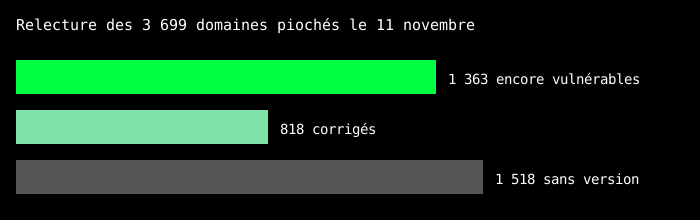
To know what is true today, we re-read the Server header of the 3,699 domains on 13 November at 12:26, in fourteen threads and 252 seconds. 1,363 domains still serve Apache 2.4.69 or 2.4.70, therefore remain exposed to the vulnerability as it was published. 818 domains have moved to 2.4.71, therefore fixed it in less than forty-eight hours, which represents twenty-two percent of the sample. 1,518 domains finally publish no version number, and those cannot be ranked either among the fixed or among the exposed. These three categories do not mix, and that is what distinguishes a count from an estimate. A silent site is not an up-to-date site, it is simply out of reading range. The same rule applies to the entire estate, where the status report as of 13 November gives the three tiers of the registry, the known names, the probed names and the live sites. We never publish a count without its date, because announcing 3,699 on 13 November would have been wrong by a factor of two and a half. An outdated photograph presented as a present state is not a drafting slip, it is a measurement error, and it is paid for in trust.
Sites that hide their version are not clean sites
They are not fixed either, and we verified rather than assumed. On twelve of these silent sites, all twelve respond server: Apache without the slightest figure, because their configuration deliberately masks the information, which corresponds to the ServerTokens Prod setting. It is not our reading that fails, it is the site that stays silent, and the difference changes everything in the way of counting. A correctly hardened site and a site never updated produce exactly the same empty response, therefore the same refusal to conclude on our part. We prefer to write that they are not judgeable rather than to rank them on the side that suits us, and this position costs us spectacular figures. It avoids, however, wrongly accusing a serious host that has simply applied hardening recommendations, which is its strictest right. The detail of version ranges, software by software, can be read in the vulnerability records, and each record indicates the range concerned as well as the fixed versions. Each record also carries the share of our estate concerned, which makes it possible to know whether the vulnerability affects three sites or thirty thousand on the perimeter we measure, and therefore to choose where to focus the effort.
A site that does not publish its version is not an up-to-date site. It is a site about which nothing is known.
What an owner can do tonight
- Ask their host which version of Apache it serves, and demand 2.4.71 or higher.
- Check the header yourself, with
curl -I https://son-site.fr, and look at theServerline. - If the number does not appear, ask the host to communicate it in writing rather than hide it.
The fixed version has been available since November 11, and Apache's official announcement lists it along with the two security advisories. Two days after its publication, about one site in five had applied it in our batch, which leaves a little more than four sites out of five in a situation that no audit can resolve on their behalf. The message to remember is not that hosting providers are slow, it is that updating a shared server does not depend on the person who owns the site. It depends on the hosting provider, who decides the schedule for all of its customers, and the owner often has no way to compel them. This is why the question to ask is not only which version is running, but when the next security update will be applied, and in writing. A dated commitment is worth more than a reassuring version number, because it can be verified at the appointed time. This is why our findings do not rank anyone, they only state what was true at the minute the reading took place. Three days later, the same batch deserves a new reading, with the same commands and the same method, and that is exactly what we do.