
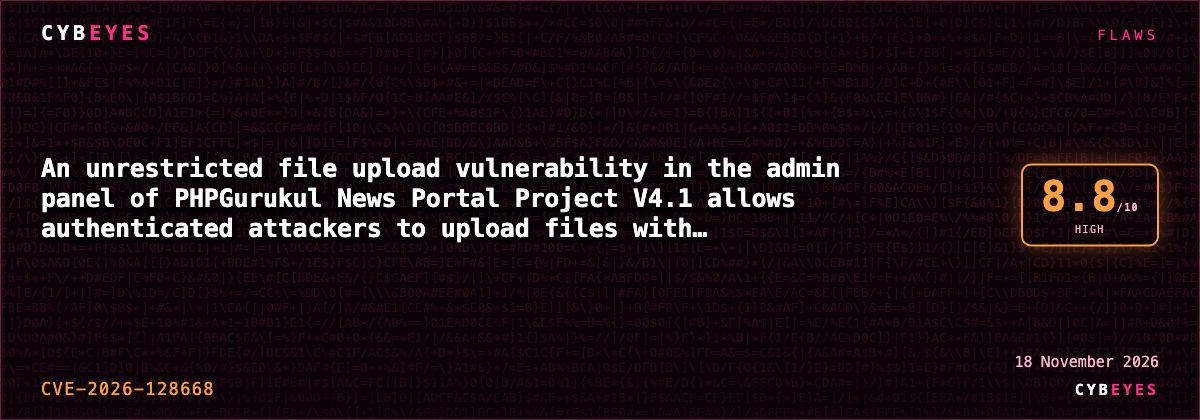
The CVSS score measures technical severity, not your exposure. Here: remote attack, with an account, with no particular condition, with no action from the victim. A high score on software you do not use does not concern you, and a medium score on exposed software still needs to be fixed.
What is the CVE-2026-128668 vulnerability ?
An Unrestricted File Upload vulnerability in the admin panel of PHPGurukul News Portal Project V4.1 allows authenticated attackers to upload files with arbitrary content by bypassing weak filename extension validation in add-post.php and change-image.php. Although files are renamed with an image extension upon storage, the lack of MIME type and content validation enables content spoofing, storage of malicious markup, and creates a vector for Remote Code Execution (RCE) with server misconfigurations or secondary Local File Inclusion.
Just before this one, two records for the same software were published: CVE-2026-128660 (18 November 2026), then CVE-2026-128662 (18 November 2026).
A version range is read like an interval, with the lower bound included and the upper bound excluded, unless the publisher states otherwise. Comparing two version numbers is not comparing two numbers. Each part is read separately, from strongest to weakest, and a maintenance release can fix a vulnerability without changing the major number. This is why a site that announces it is "up to date" can still be vulnerable if its version is earlier than the fix bound. The only way to decide is to read the number actually published by the site, then compare it to the bound. When a site publishes no number, no conclusion is possible, and we record "not assessable" rather than assume a version. A flattering assumption is more dangerous than no answer, because it puts people to sleep. Also beware of branches maintained in parallel. A publisher can fix the same vulnerability on three different branches, with three different numbers, and the published bound applies only to the branch it names.
Which software and version are affected by the CVE-2026-128668 vulnerability ?
- n/a — versions non publiées
The software named above is the one the advisory identifies as vulnerable, along with the affected version range. A range is read as an interval, lower bound included and upper bound excluded, unless the vendor states otherwise. The version published by a site is read from its served files, not from its administration interface, because that is what an attacker sees. A site that declares itself up to date can therefore remain vulnerable if its version is earlier than the fix threshold. Conversely, a backported patch closes the flaw without changing the major number. We therefore never conclude on the sole number displayed by a vendor. When a site publishes no version, we write "not assessable" rather than assume.
Are French sites affected by the CVE-2026-128668 vulnerability ?
How to fix the CVE-2026-128668 vulnerability ?
Fixing is done in a specific order, and that order matters as much as the fix itself. First, identify the version in place, without relying on the administration display, because a number is read in the served files and that is what an attacker sees. Then back up, then update to a version later than the threshold indicated by the publisher. If a direct update is not possible, apply the security patch published for your branch, which closes the flaw without changing major version. Finally verify, by re-reading the number after the operation and confirming that the page that caused the problem still responds. An unverified update is a presumed update. If the software is no longer maintained, the only solid answer is replacement, because an isolated patch on an abandoned branch will not hold against the next flaw. Also consider what surrounds the software. Extensions, modules and themes follow their own schedule, and a core update does not fix a faulty module. Finally, note the date of your fix; it will serve later to prove that the flaw was closed before being exploited.
- Identify the installed version of the affected software.
- Apply the update that goes beyond the fixed limit published above.
- If the update is not possible, disable the component or remove the exposed feature.
- Check afterwards that the installed version is well beyond the threshold, using the same command that was used to read it.
Where to find the fix and the proofs for the CVE-2026-128668 vulnerability ?
No public evidence recorded to date. Son absence ne veut pas dire que personne ne l'exploite : une attaque qui réussit ne se publie pas. 1 references published for this flaw, 1 of them shown here. The list starts with what fixes it (commit, patched release, affected code), then the vendor advisory, then public evidence. Each link opens the original source in a new tab.
- Affected code in dharmstm/PHP-GuruKulgithub.com
Other vulnerabilities in the same module
- 18 novembre 2026CVE-2026-128660 : 4.8Mediumn/a
- 18 novembre 2026CVE-2026-128662 : 7.5Highn/a
- 18 novembre 2026CVE-2026-128664 : 8.3Highn/a
- 18 novembre 2026CVE-2026-128665 : 6.1Mediumn/a
- 18 novembre 2026CVE-2026-128666 : 6.1Mediumn/a
- 18 novembre 2026CVE-2026-128669 : 7.1Highn/a